
How to Learn Poker at Home: 5 Free Ways to Practice Safely
How to Learn Poker at Home: 5 Free Ways to Practice Without Risking Your Bankroll
Learning poker rarely happens in a quiet room with unlimited time. More often, there is a free hour after dinner and a laptop on the kitchen table. The goal is therefore a small, structured practice session that fits into an ordinary evening and costs nothing.
A good learning routine combines theory with practical examples. Beginners can use free tutorials, poker communities, and educational platforms to understand the rules and become familiar with different online gaming formats before deciding which ones interest them most.
Why Poker Is Easy to Study at Home
The main advantage is that mistakes cost nothing. At home you can pause a hand, think for five minutes, and check your logic before acting. You can replay a decision that went wrong and ask why it went wrong, which is much harder at a live table.
Poker also rewards small, repeated sessions. Twenty focused minutes with one clear question usually teach more than three hours of unfocused play. Instead of “get better at poker”, choose a task such as “decide which starting hands I will play from late position”.
1. Play Free-Money Games with a Specific Goal
Play-money tables are the simplest entry point. They are not perfect, because players often take risks they would never take with real money. Still, they are useful for learning the rules, the order of betting rounds, and the flow of a hand.
Give every session one job:
- practise folding weak hands before the flop;
- pay attention to your seat position on every hand;
- note how often you bet when you hold a strong hand versus a draw.
If the session has no goal, it becomes passive clicking.
2. Use Free Training Tools and Quizzes
Many poker sites and independent trainers offer free quizzes, starting-hand charts, and basic odds calculators. They show which decisions are standard and which are costly habits.
When exploring online gaming platforms, it is also useful to understand how different games and formats work. For example, an online casino may offer slots and live dealer tables, where players can observe real dealers managing games through live video streams. Although these formats differ from poker, exploring their rules and mechanics provides a broader understanding of online gaming entertainment.
Choose one training tool and finish a full set of exercises before looking for another. Opening ten tabs of tutorials feels productive, but one clear explanation followed by practice is worth more than a folder of saved links.
3. Practise with Friends for Chips, Not Cash
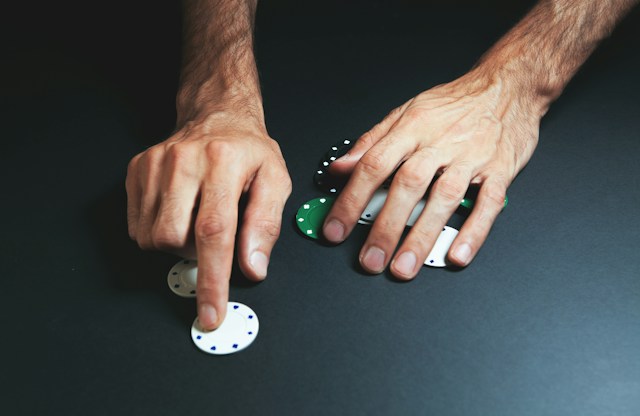
A home game with matchsticks, buttons, or cheap plastic chips adds something software cannot: real people. You learn to read timing, notice hesitation, and handle conversation at the table.
Keep the rules simple. Agree on blinds, a fixed number of starting chips, and an end time. If anyone is tempted to add money to make it “more interesting”, the practice purpose is lost. The aim is learning, not winning.
4. Review Your Hands in a Short Journal
A notebook or spreadsheet is one of the strongest free tools. After each session, record three or four hands that confused you. For each one, write:
- your position and your cards;
- what you did and what you were thinking;
- what you would try differently next time.
Within a few weeks, patterns appear. You may notice that you call too often or that you lose focus late in the evening. That kind of insight comes from your own play, not from a general guide.
5. Learn the Basic Math in Small Steps
Poker maths sounds intimidating, but the beginner version is short. Start with counting outs, the cards that improve your hand, and use the simple “rule of 2 and 4” to estimate your chance of hitting on the next card or by the river. Then learn pot odds, which compare the price of a call with the size of the pot.
Practise on real examples from your journal rather than on abstract tables. When the numbers describe a hand you actually played, they are much easier to remember.
Keep Practice Separate from Real Money
Free practice builds skills, but it does not guarantee results. Poker involves luck, and even experienced players have losing sessions. If you later decide to play for real money, a few rules help:
- set a fixed budget before the session and treat it as the cost of entertainment;
- stop when the time or budget limit is reached;
- take a break after emotional hands instead of playing to recover losses;
- play only where it is legal and only if you are of legal age.
Poker is a game for adults, and no tool or strategy removes the risk entirely.
How to Judge Your Progress
Progress shows in what you can now do. Folding a tempting but weak hand, explaining why a bet was too small, or calculating pot odds without a chart says more than the number of videos watched. Once you have chosen your tools, stay with them long enough to complete a small project, such as a month of reviewed hands. Before ending each session, write down your next action, because returning is easier when that decision has already been made.